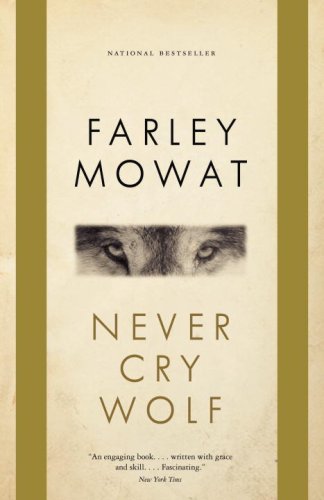
Farley Mowat’s 1963 novel Never Cry Wolf follows the author on an expedition through the Canadian Artic. He is tasked with studying wolves and making a conclusion regarding the reason for the rapid decline of the Caribou population in the area. The book has been classified by many as almost entirely fictional, though Mowat did in fact take part in an expedition, and he maintains that much of the novel is based on his actual experiences. I can’t speak to the accuracy of Mowat’s conclusions about wolf behaviour as I am not an expert on the subject myself, though I can say that I believe this novel is an important and effective addition to the collection of literature that began to push back on the hatred of wolves that permeated our culture for so long.
Be warned, Never Cry Wolf is very clearly a product of its time. Mowat’s language is not the most accessible for a modern-day reader, and his writing often seems complicated and even pretentious at times. It also makes extensive use of the word Eskimo, which is the topic of much debate these days, and which many say is an outright slur. I do not believe Mowat intended to be offensive in this novel. In fact, I think he often goes out of his way to show how the Indigenous characters in the novel are much more effective naturalists than himself and his colleagues. Regardless of his intent, however, his writing, like that of so many other authors during his time, shows a lack of attention and understanding towards these cultures.
Despite its weaknesses, I quite enjoyed reading Never Cry Wolf. I am the son of two naturalists myself, and found Mowat’s depiction of his expedition very familiar. Mowat sprinkles a dry humour throughout the novel that is typical of those who spend most of their time studying creatures that cannot inform them of their oddness. This humour is also typical of his era of writing. He states in his introduction that his original intention for the novel was to create the wolf as a foil to the bureaucrats that sent him on his journey. This attitude positions his novel nicely into his postmodern era, which had a healthy distrust of authority, and whose authors often used irony and humour to show the reader the consequences of a society that placed too much stock in the status quo.
All things considered, Never Cry Wolf was a fun read. Very short and to the point, Mowat’s writing, while outdated and a little complicated, kept me entertained and chuckling. His love of wolves is obvious in the novel, and his depiction of the Arctic tundra, contrary to the legendary and lonely Arctic from Jane Eyre’s imagination, is lively and full of excitement.
 Rory Reads