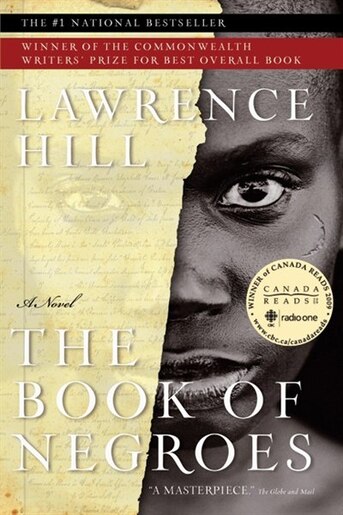
Every so often I know that I’m going to feel like I’m doing a novel a disservice by writing a 500 or so word blurb about my surface thoughts on it. The Book of Negroes by Lawrence Hill is one of those novels. I am in no position to truly understand the complexities of the novel or the pain depicted in it, and thus I will not try to write about them here. As an English major, however, I will give my point of view and say that Hill’s novel is excellently written and is without a doubt one of the greatest pieces of Canadian fiction of all time.
Hill’s story follows the life of Amanita Diallo, a girl from Bayo on her journey as a slave and a free woman through South Carolina, New York, Nova Scotia, Freetown, and London. Amanita is asked to be the face of the abolitionist movement in London and to write her story for the world to read. In this story, Amanita survives many hardships thanks to her skill as a midwife, her affinity for writing and reading, her abilities as a teacher, and with the help of many friends along the way. Though a work of fiction, Hill draws upon his knowledge of history to inform his work and presents Amanita’s story with reference to real places and true events.
Amanita Diallo is one Canada’s most well-known and well-written characters. Hill stacked up the awards for this novel, winning Canada reads and the Commonwealth Writers’ Prize. These awards are absolutely deserved.
The Book of Negroes is a wonderful addition to the library of contemporary Canadian literature, and Hill shows a master’s understanding of post-postmodernism in his writing. He fully engages the modern reader and offers an intense and singular look at a piece of history that many try to distance themselves from. While we have all learned about the evils of slavery, Hill’s writing brings this history off the page and allows his reader to understand it in an entirely new and intimate way. At the start of the novel, we are introduced to Amanita in her dying days and are told that the novel will recount her life. Though we already know the end of her story, the highs and lows of her life are not dulled in the slightest. In the same way, though we understand the history of slavery, the pain and hope that Hill conveys through Amanita is astonishing. His research and attention to detail combined with his excellent writing make this novel both highly educational and incredibly emotional. I found myself struggling to turn the page on several occasions, and I am not ashamed to admit that there are water stains in every chapter of my copy of the novel.
Aside from being excellently written, The Book of Negroes is an abundantly important novel that I believe everyone interested in American or Canadian literature or history should read at some point in their lives. Especially in today’s climate, I think that we should take any and every opportunity to educate ourselves and to listen to voices like Lawrence Hill in The Book of Negroes.
 Rory Reads